

Company Overview
GeneDx Holdings Corp. (WGS) is a diagnostics company specializing in advanced exome and genome testing services. The company's strength in interpreting diagnostic data is underpinned by a proprietary and rapidly expanding dataset of rare diseases, GeneDx Infinity, that continues to expand and become more diagnostically accurate and relevant as a result of intelligence derived from thousands of tests each year.
The company's testing services have been focused on the pediatric outpatient and neonatal ICU settings. However, 2026 will begin to see contributions from expanded offerings as the company benefits from a gradual shift in healthcare policies and recommendations of medical associations. The company has worked closely with state Medicaid programs, the National Institutes of Health (NIH), and medical associations to expand newborn genomic screening. Last year, the American Academy of Pediatrics [AAP] updated guidelines to recommend exome and genome sequencing as first-tier tests for children with developmental delays. For more background context, readers can refer to the June 2024 initial report, Mapping a Path to Leadership, and subsequent updates.
Preliminary Report
The company released its preliminary fourth quarter results on January 12, before its presentation on January 14 at the J.P. Morgan Healthcare Conference. This discussion of the fourth quarter is based on these approximate numbers, and actual numbers can vary.
The table below presents the total revenues.

The testing volume for whole exome and genome (WEG) business accelerated in the fourth quarter, as expected, and achieved the full year objective of 30% annual growth.

The company also initiated topline guidance for 2026, which was better than the consensus expectation.

Early Impressions
The fourth quarter numbers met the guidance but did not exceed it in any meaningful manner, a prerequisite for higher multiple stocks. Perhaps the significant beat and raise in the earlier quarters left little room for further outperformance.
WEG Testing Revenues
WEG testing volume for the fourth quarter will grow 8% sequentially, and 34% Y/Y. The growth in testing volume matched the guidance.
Average test pricing, the other lever to boost revenue growth, can be implied for the fourth quarter. The table below presents the quarterly pricing for 2025.

Pricing per test improved steadily in 2025, only to dip in the fourth quarter. A significant portion of the pricing improvement during 2025 has been driven by maturing claim processes, which in turn reduce rejections by commercial and state payers. The paid rate on claims filed was in the 55%-60% range in the third quarter, and the company believes it has room to improve this rate to around 75%.
With the addition of new service offerings in NICU, pediatric neuro, outpatient settings, and now the upcoming general pediatric opportunity, the company expects to see lower collection or paid rates in the next few quarters as claim codes and payment processes catch up within the new channels. This will lead to a pullback in blended reimbursement rate and the average test pricing.
The fourth quarter likely reflects such an impact, where a growing portion of tests are from newer services with lower collection rates and still maturing payment processes. This means that the average pricing rate may continue to trend lower for much of 2026 as newer services build up momentum, and then turn around and head higher as reimbursement rates climb. The pricing pullback does not appear to be affecting profitability, as evidenced by the company's gross margin guidance discussed below. The company is likely to provide more granularity into pricing dynamics during the full release on February 23, 2026.
Gross margin is expected to be 71% for the quarter. It is important to note that even with a dip in test pricing, the company was able to maintain per-test profitability of 70% to 71% and guided to a 2026 gross margin of at least 70%. This resiliency in gross margin stems from significant automation and AI-related efforts to bring the cost of services (COGS) down, which the company has indicated in the past.
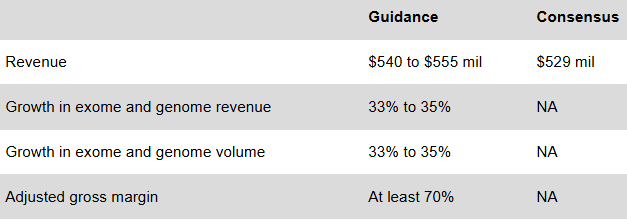
The 2026 guidance is stronger than expected. It is noteworthy that the company expects WEG volume growth to be 33% to 35%, even ahead of the 30% volume growth in 2025. The strong 2026 growth is also notable, as after the second quarter 2025 results, there were investor doubts if the company will be able to achieve testing volume growth of 30% for 2025, which was discussed in an earlier report Market Misreads Test Volume Dip.
The strong 2026 guidance shows that the company expects its newer high-opportunity growth vectors to begin contributing meaningfully in 2026.
Conclusion
The company's fourth quarter was marginally better than expectations, and the size of the beat proved to be underwhelming for a high P/E stock. The near-term momentum has been lost. The stock is likely to consolidate and then edge higher in anticipation of the next earnings season in April.
However, the business model remains robust and is strengthening as new service offerings come online. The largest of these opportunities can prove to be the general pediatrician market, where 600,000 patients are diagnosed each year with developmental delay and intellectual disability by pediatricians who can use a gene diagnostic tool, particularly after the recommendation of the AMA. The company is scaling up for the opportunity, which is likely to make an impact in the fourth quarter of this year, and is designing a one-minute ordering system to make it easy and seamless for the pediatricians to leverage genomic testing.
As we have noted in the past, the company is benefiting from trends that are robust, timely, and gaining regulatory momentum. State and commercial payer coverage has been growing, with GeneDx contracted with 80% of covered lives. Medicaid programs in 37 states cover exome or genome testing.
The GeneDx Infinity dataset is unique and has become a leading brand for genomic testing in the target population. The company has noted that 8 out of 10 clinical geneticists order testing services from GeneDx, and after just over two years of offering the service, 1 out of 3 pediatric neurologists order from GeneDx. The company now has an early mover advantage in the much larger general pediatrician market. The dataset and its market reach can potentially position the company as an attractive consolidation play.
The stock price of GeneDx has declined over 36% from its high. After the earnings announcement this week, shares have fallen 20%. The stock is likely to consolidate for the quarter and will require patience, but it can potentially prove to be a highly rewarding opportunity over the year. The fundamentals remain strong, and potential catalysts can include the presentation at the J.P. Morgan conference, which can clarify any perceived issues, the launch of services into the pediatrician market, and growing traction in the NICU and interpretation service.
GeneDx has been a position in our Prudent Healthcare and Prudent Small Cap model portfolios, and we can adjust such positions based on the portfolio rules. Positions and opinions are subject to change without notice. Investors should conduct due diligence, size their positions based on their risk profile, and be mindful of the risks associated with small-cap growth stocks.
(The article was first published on Seeking Alpha)
